By Aare Amerijoye DOT.B
There are moments in politics when the arithmetic becomes more revealing than the propaganda. The louder the defenders of incumbency insist that 2027 is already settled, the more important it becomes to examine the numbers, the political realignments and the changing national mood beneath the surface.
President Bola Tinubu won the 2023 presidential election. That is a fact. But the election did not produce a majority mandate. Tinubu polled 8,794,726 votes, while Atiku Abubakar recorded 6,984,520 and Peter Obi 6,101,533. The result was a plurality, not an overwhelming national endorsement.
That distinction matters.
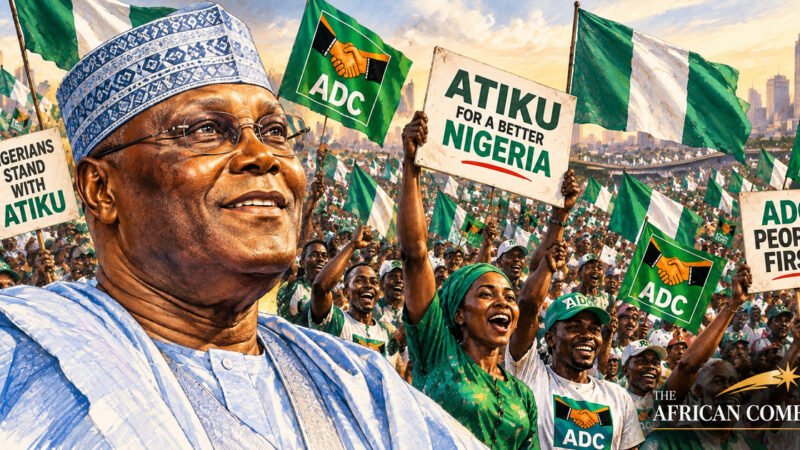
The 2027 presidential election is no longer an abstract political conversation. INEC has published the final list of candidates for the 16 January 2027 election. Tinubu is contesting under the APC with Kashim Shettima. Atiku is contesting under the ADC with Rotimi Amaechi. Obi is contesting under the NDC with Rabiu Kwankwaso.
The political configuration has therefore changed fundamentally.
And anyone assuming that the 2023 map will simply reproduce itself in 2027 is ignoring the most important reality of Nigerian politics: elections are fought afresh, alliances change, voters change and political circumstances change.
ATIKU’S NATIONAL FOOTPRINT CANNOT BE WISHED AWAY
Atiku’s greatest political asset is not propaganda. It is his demonstrated national reach.
The official INEC figures from 2023 tell a story that cannot honestly be erased.
In the North East, Atiku’s platform recorded 1,741,846 votes, representing 51.71 per cent among the four leading parties. Tinubu’s APC recorded 1,185,458.
In the North West, Atiku’s platform recorded 2,329,540 votes against Tinubu’s 2,641,306. The NNPP also recorded 1,268,250, demonstrating that the region was far from a monolithic political territory.
In the North Central, Atiku recorded 1,162,087 votes, while Tinubu recorded 1,760,993 and Obi 1,415,557.
The message is unmistakable.
Atiku is not a regional candidate.
He demonstrated the ability to command millions of votes across the country, including substantial support outside the North.
That is the foundation upon which his 2027 campaign can be constructed.
THE SOUTH IS NOT A POLITICAL MONOLITH
The same arithmetic becomes even more interesting when the South is examined without partisan exaggeration.
In the South West, Tinubu’s APC recorded 2,279,407 votes. Atiku’s platform recorded 941,941, while Obi’s recorded 849,423.
Yes, Tinubu had a substantial advantage in the zone.
But a regional advantage in 2023 does not constitute a permanent electoral inheritance for 2027.
In the South South, the figures were much more competitive. Obi’s platform recorded 1,210,675 votes, Tinubu 799,957 and Atiku 717,908.
The South East was overwhelmingly dominated by Obi, who recorded 1,960,589 votes, while Tinubu recorded 127,605 and Atiku 91,198.
These numbers should not be manipulated.
But neither should they be treated as permanent political laws.
The South East will vote again in 2027. The South South will vote again. The South West will vote again. And the political circumstances under which those voters make their choices will not necessarily be identical to those of 2023.
That is the reality Tinubu’s campaign must confront.
ATIKU DOES NOT NEED OBI’S VOTES
This is where some political commentators make a fundamental mistake.
They assume that because Atiku and Obi both contested in 2023, Atiku’s 2027 prospects depend upon somehow inheriting Obi’s electorate.
They do not.
Atiku does not need to become Obi.
He does not need Obi’s votes to be mathematically transferred to him.
He needs to build his own coalition.
The 2023 election already established the existence of an Atiku constituency running into millions of Nigerians across different geopolitical zones.
The task for 2027 is to consolidate that constituency, expand it and persuade additional voters to support the ADC ticket.
That is a more realistic and more powerful political strategy than pretending that another candidate’s electorate belongs automatically to Atiku.
THE NORTH CANNOT BE TREATED AS TINUBU’S GUARANTEED RESERVOIR
Perhaps one of the greatest misconceptions surrounding 2027 is the belief that the North automatically belongs to the incumbent.
The 2023 results do not support that assumption.
Atiku won the North East decisively in 2023. He was highly competitive in the North West. He maintained a substantial vote in the North Central.
The North West itself demonstrated a complicated political picture, with APC, PDP and NNPP all securing substantial support.
Therefore, the argument that Tinubu simply owns the northern electorate is unsupported by the historical voting pattern.
The same voters who made one decision in 2023 will be presented with a different set of circumstances in 2027.
Political loyalty is not always permanent.
AMAЕCHI CHANGES THE GEOGRAPHY OF THE ADC TICKET
Rotimi Amaechi’s position as Atiku’s running mate also gives the ADC ticket another dimension.
Amaechi is not simply a name on a ballot paper. He is a former governor, former Minister of Transportation and a prominent southern political figure.
His presence does not automatically transfer votes to Atiku. Politics does not work that mechanically.
But it gives the ticket additional political networks and a recognisable southern figure around whom mobilisation can be organised.
For a presidential ticket seeking to build a national coalition, that matters.
Atiku’s challenge is therefore not to rely on one region. It is to combine his established national reach with an expanded southern coalition and a disciplined national campaign.
TINUBU’S 2023 PLURALITY IS NOT A 2027 GUARANTEE
This is the central point.
Tinubu won in 2023.
But 2027 is not 2023.
The economy is different.
The political alliances are different.
The opposition structure is different.
The candidates are different.
The electorate’s experience of the intervening years is different.
And the issues voters will consider are different.
A previous victory provides incumbency, political machinery and an established national platform. It does not provide a constitutional guarantee of another victory.
That is why the 2027 contest cannot honestly be described as settled before Nigerians vote.
WHY THE FEAR OF A DIRTY FIGHT?
This is where the title of this article becomes politically significant.
When an incumbent faces a serious challenger, the temptation in any political system can be to deploy every available political instrument to preserve power.
But allegations of a predetermined “dirty fight” should not be presented as established fact without evidence.
What Nigerians should watch carefully is the conduct of the political process itself.
Watch the institutions.
Watch the electoral environment.
Watch the use of state power.
Watch campaign financing.
Watch political rhetoric.
Watch the courts.
Watch the security architecture.
Watch the treatment of opposition politicians and campaign organisations.
And above all, watch the integrity of the electoral process.
These are the areas in which political competition must be judged by evidence rather than rumours.
The responsibility is not merely on the opposition. It is also on institutions, political parties, civil society, the media and ultimately the electorate to insist that the 2027 contest is fought on issues, records, policies and votes.
ATIKU’S CASE IS NOT BUILT ON WISHFUL THINKING
Atiku’s 2027 case does not require exaggerated mathematics.
It does not require pretending that every Obi voter will suddenly become an Atiku voter.
It does not require declaring victory before the election.
It requires something more straightforward.
A demonstrated national electoral base.
A political platform capable of expanding beyond its previous boundaries.
A running mate with substantial political experience and southern networks.
A message capable of connecting with Nigerians across regions.
And a campaign organisation capable of converting political goodwill into actual votes.
Atiku has already demonstrated the first of these.
The 2023 result gave him 6,984,520 votes nationally. He won substantial support across the North and maintained meaningful support in the South. He demonstrated that his political appeal could travel beyond one geopolitical zone.
The ADC platform now provides a different political vehicle for the 2027 contest.
The question is whether that vehicle can be organised effectively enough to expand Atiku’s electoral coalition.
That question will be answered by voters.
TINUBU CANNOT AFFORD TO CONFUSE INCUMBENCY WITH IMMUNITY
This is the point the APC should understand.
Occupying Aso Rock is an enormous political advantage.
But it is not immunity from electoral accountability.
The 2027 election will inevitably become a referendum of sorts on the record of the incumbent administration, alongside a contest between competing alternatives.
Atiku will have to defend his own record and explain his own programme.
Obi will have to do the same.
Tinubu will have to do the same.
Every candidate will have to persuade Nigerians.
No amount of political noise can permanently substitute for that fundamental democratic transaction.
THE REAL BATTLE IS FOR NIGERIANS WHO CAN STILL BE PERSUADED
The electorate is not frozen in 2023.
Some Tinubu voters will remain with him.
Some Atiku voters will remain with Atiku.
Some Obi voters will remain with Obi.
Others may change their minds.
And there are Nigerians who did not participate in 2023, as well as voters whose political priorities have changed since then.
That is where the 2027 contest becomes unpredictable in the ordinary sense of electoral competition.
The parties must earn votes.
The candidates must earn trust.
The campaigns must persuade.
And Nigerians must decide.
THE 2027 BATTLE HAS ONLY ONE CERTAIN OUTCOME: NIGERIANS WILL CHOOSE
Tinubu’s incumbency is real.
Atiku’s national electoral footprint is real.
Obi’s 2023 support base is real.
The other presidential candidates are real.
The political fragmentation is real.
The electoral competition is real.
What is not yet a fact is the outcome.
That will be determined by Nigerians on election day.
But those who believe that Atiku can simply be dismissed because Tinubu is an incumbent are ignoring the evidence of 2023 and the political changes that have occurred since then.
Atiku enters 2027 with a documented national electoral foundation.
He has an ADC platform.
He has Rotimi Amaechi beside him.
He has an established political network.
And he has the opportunity to build a wider national coalition.
That does not make victory automatic.
It makes the contest serious.
And that is precisely why the coming election should not be reduced to the simplistic assumption that incumbency alone has already decided it.
The ballot is fixed.
The candidates are known.
The campaign has entered a decisive phase.
Now the arguments must be made.
The records must be examined.
The promises must be tested.
The institutions must be watched.
And ultimately, the Nigerian people will decide.
Aare Amerijoye DOT.B
Director General
The Narrative Force