
Atiku’s demand that INEC publish the voters’ register rests on three things the commission cannot wish away: the Electoral Act, the calendar, and its own chairman’s words.
Thursday, October 22, 2026
A voters’ register is a nation’s mirror. Every citizen should be able to walk up to it and find their own face. INEC has hung the mirror, announced that it holds more than 103 million faces, and thrown a cloth over the glass.
That, in short, is the complaint former Vice President Atiku Abubakar, the ADC presidential candidate, laid before the country on Thursday. In a statement signed by Phrank Shaibu, Director of Strategic Communication of the ADC Presidential Campaign Council, he demanded the immediate publication of INEC’s preliminary register.
“A figure cannot answer an objection. A press announcement cannot tell a voter whether her name has been omitted. Show Nigerians the register,” the statement said.
It would be easy to file this as one more opposition grievance. The record will not allow it.
The screen is blank. INEC fixed October 9 to 15 for public scrutiny of the register. When that window closed, and for days afterwards, the commission’s online portal carried a single line: “There are currently no preliminary registers to display.” The Foundation for Investigative Journalism reported the empty portal on October 16 and again on October 18. Premium Times found the same message on October 21.
The law is plain. Section 19(1) of the Electoral Act 2026 requires the register for each local government, area council and ward to be displayed or published “at every registration area and on its official website.” The two venues are joined by “and”, not “or”. Section 19(5) goes further and makes an official’s failure to display or publish the register an offence. Online access is not a courtesy INEC may extend when convenient; it is a duty with a penalty attached.
The clock has struck. With the presidential and National Assembly elections fixed for January 16, 2027, the Act’s 90-day mark fell on October 18. It came and went with the website still empty.
INEC’s answer. The commission’s spokesperson, Mohammed Haruna, told Premium Times that the register was displayed at registration areas from October 9 to 15, and that claims and objections are now being compiled towards a clean register due by December 15. Physical display matters, and it deserves acknowledgement. But it does not discharge the separate duty to publish online. A register cleaned before millions could inspect it is a house swept behind closed doors: no one outside can tell whose names went out with the dust, or which strangers were let in.
The dates disagree. On October 5, four days before the display window opened, INEC chairman Joash Amupitan told editors in Abuja that the 103 million figure followed, among other steps, “the completion of the public display of the Preliminary Register.” Then the display began. Both statements cannot describe the same exercise. Until INEC explains the difference, Nigerians are entitled to ask which one is true.
The ballot question. Atiku also returned to Section 63(2), which obliges a returning officer to count a ballot paper lacking INEC’s official mark if he is satisfied it came from a book issued to that polling unit. The provision is inherited from earlier electoral law, and Atiku called it a loophole as far back as April. The Act does hold the bricks of a safeguard: ballot papers must be serially numbered (Section 42(2)), and their serial numbers must be recorded at each polling unit before voting begins (Section 73(2)). The real question is whether INEC will tie every Section 63(2) decision to those records, in full view of party agents, or leave it resting on one officer’s word. The Atiku statement adds that INEC has yet to say which companies are printing sensitive election materials.
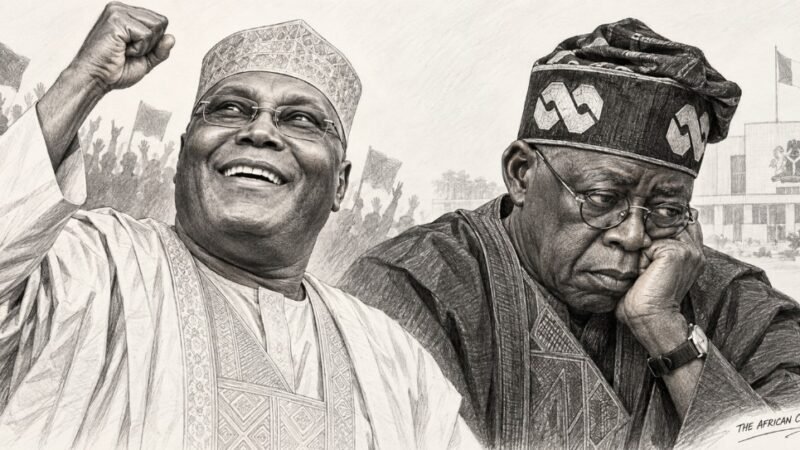
The President’s stake. Atiku’s statement addressed President Bola Tinubu by name. Nothing on the record shows that the President directed this lapse. But he need not have touched the register to inherit its shadow. An administration already answering for economic hardship and insecurity cannot afford to see its mandate, whatever the voters decide, rest on a list the public was never shown.
An empty screen does not prove a rigged register. But darkness is where suspicion breeds, and suspicion, once hatched, does not crawl back into its shell. This newspaper’s creed is that truth travels further. It cannot travel at all while it sits locked in a server in Abuja.
INEC’s road back to public trust is short:
• Publish the register online, by local government, area council and ward.
• Reconcile its own dates, and say which account is correct.
• Give voters a real window, online as well as at registration areas, to file claims and objections.
• Explain how Section 63(2) decisions will be checked against recorded ballot serial numbers.
Nigeria cannot afford another election whose credibility is settled in the courtroom rather than at the polling unit. One hundred and three million voters cannot remain a number on INEC’s computer.
Publish the names. Protect the ballots. Restore public confidence.