Atiku campaign strategist says Nigerians’ economic hardship, not defections or political endorsements, will decide the 2027 presidential contest
By Odion David
ABUJA, October 13, 2026 — Dr. Pedro Obaseki, a Director on the African Democratic Congress (ADC) Presidential Campaign Council and Adviser on Policy and Strategy to the party’s presidential candidate, Atiku Abubakar, has said the party’s own electoral assessment covers 24 states, dismissing suggestions that defections and endorsements have decisively altered the landscape ahead of the January 16, 2027 presidential election.
Obaseki spoke on Monday evening in an extensive interview with Charles Aniagolu on ARISE News’ flagship current-affairs programme, Prime Time, covering the state of the opposition, Nigeria’s cost-of-living crisis, Atiku’s economic proposals and concerns over political intimidation.
Responding to questions about the ADC’s prospects and the fragmentation of the opposition, Obaseki acknowledged that rival opposition parties were in the field but challenged the assumption that defections translate into votes.
“Defections don’t change the electoral map,” he said.
He said the ADC’s assessment went beyond the 20-state projection referenced during the discussion, putting the campaign’s own figure at 24 states.
The Director-General of the APC Presidential Campaign Council, Abdulaziz Yari, said last week that Tinubu already controls more than ten states across the North and South, and dismissed Atiku and the Nigeria Democratic Congress candidate, Peter Obi, as serious threats.
‘Wike Cannot Speak for Voters’
Turning to the Federal Capital Territory Minister, Nyesom Wike, and his declaration that he had secured Rivers State and the FCT for President Bola Tinubu, Obaseki argued that such pronouncements overlooked the economic circumstances confronting ordinary Nigerians. Wike, who remains a member of the PDP while backing Tinubu’s re-election, has named himself coordinator of the President’s campaign in both territories.
Of voters in Rivers and the FCT, Obaseki said their daily financial struggles were more immediate than any assurance from political leaders. “His pocket speaks to him daily, not Wike,” he said.
In his assessment, the 2027 contest will be decided less by declarations of political control than by how Nigerians experience the government’s economic policies.
Nigerians ‘Almost 700% Poorer’
In one of the interview’s most striking moments, Obaseki claimed that Nigerians had become almost 700 per cent poorer since President Tinubu took office on May 29, 2023. The line was prominently highlighted by ARISE News.
The claim reflected his criticism of declining purchasing power, rising energy costs and the cumulative burden of the administration’s economic reforms. Official data do show a rise of that order in the price of petrol: the regulated pump price was about ₦185 a litre in early 2023, while the National Bureau of Statistics recorded a national average of ₦1,596.25 in May 2026, more than eight times higher.
Obaseki argued that petrol and energy costs had become central to Nigeria’s economic and electoral debate, affecting households across regional, religious and political lines. He also challenged the practice of judging economic performance mainly by macroeconomic statistics, insisting that the administration should be assessed by whether ordinary Nigerians can afford food, transport, energy and other necessities.
Defends Atiku’s Economic Alternative
Obaseki defended Atiku’s proposal for a production subsidy, under which qualifying domestic refineries would receive crude at preferential prices, within an annual ceiling approved in the federal budget and subject to a sunset clause. He presented it as an alternative to the former system of subsidising imported finished products.
He said the former vice-president had consistently set out policy alternatives and that the campaign was focused on practical responses to the country’s economic difficulties.
He also questioned what he described as the administration’s habit of attacking Atiku’s proposals while adopting their reasoning. The exchange follows NNPC Retail’s announcement last week of a 30-day petrol price discount at its stations, a move Atiku says copied his idea and shrank it.
The government rejects the comparison. In August, President Tinubu said the subsidy proposal showed serious ignorance of governance and the economy, only to announce a 30-day discount regime after Atiku announced his petroluem product subsidy.
Power Versus Pocket
Throughout the interview, Obaseki returned to what he called the defining question of 2027: Affordability – whether Nigerians will judge the administration by the political strength of its supporters or by the consequences of its policies. The scale of hardship, he argued, was something endorsements, defections and declarations of territorial control could not erase.
Atiku–Amaechi Ticket Built on Experience
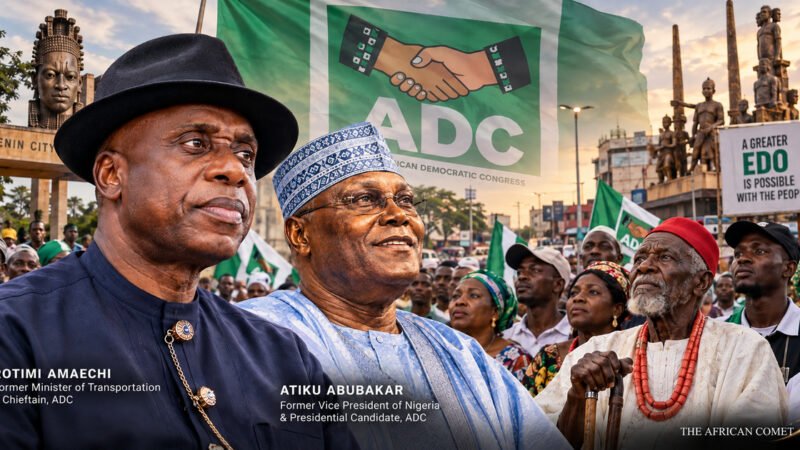
On the ADC ticket, Obaseki described the pairing of Atiku and former Rivers State Governor Rotimi Amaechi as one that brings together executive experience, political reach and regional representation.
He cited Amaechi’s years in public office as Speaker of the Rivers State House of Assembly, two-term governor of the state and federal Minister of Transportation, alongside Atiku’s long engagement with national economic and governance policy. National leadership, he argued, requires an appreciation of Nigeria’s diverse political and regional interests.
Political Intimidation and the Edo Experience
The interview also addressed Obaseki’s reported abduction and assault in Benin City in December 2025, an incident that prompted legal action and appeals to human rights institutions.
He recounted his efforts to seek redress, including the involvement of the human rights lawyer Femi Falana, SAN, and engagement with institutions outside Nigeria. He said traditional leaders later intervened and that he ultimately did not collect the ₦500 million associated with his legal claim.
Addressing threats against opposition figures and supporters in Edo State, he said intimidation should not prevent legitimate political activity. He pointed to the recent ADC town hall in Benin City featuring the vice-presidential candidate, Rotimi Amaechi, as evidence that opposition engagements could proceed peacefully despite a tense political atmosphere.
Obaseki expressed confidence in Atiku’s candidature, describing the coming election as a defining moment for Nigeria. Whether the ADC’s 24-state projection holds will be settled at the polls on January 16, 2027. But Obaseki’s argument was unmistakable: the political declarations of influential individuals cannot substitute for the independent choices of millions of Nigerians confronting the daily realities of economic hardship.