Why a quiet meeting in Abuja has stirred political interest ahead of 2027
NEWS ANALYSIS | THE AFRICAN COMET
AISHA BUHARI’S VISIT TO ATIKU: COURTESY, CONTINUITY AND THE POLITICS OF SYMBOLISM
Why a quiet meeting in Abuja has stirred political interest ahead of 2027
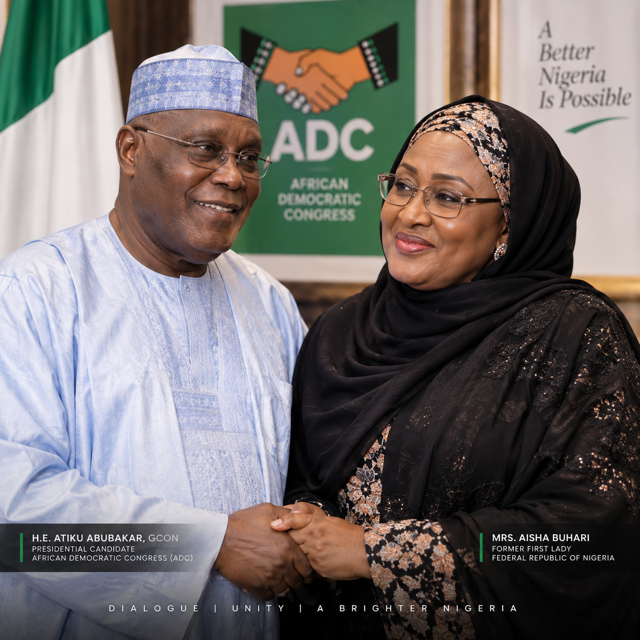
Former First Lady Aisha Buhari’s visit to former Vice-President and African Democratic Congress presidential candidate Atiku Abubakar in Abuja on Wednesday was, on the surface, a meeting characterised by warmth and courtesy.
But in Nigerian politics, particularly only months before a presidential election, photographs sometimes speak almost as loudly as communiqués.
Atiku disclosed the meeting on Wednesday, describing the former First Lady’s visit as “warm and deeply appreciated.” Reports and photographs from the encounter showed Mrs Buhari accompanied by members of the Buhari family.
Though there has been no public statement from Mrs Buhari publicly endorsing Atiku, yet that does not make the meeting politically insignificant.
It comes a little over a year after the death of former President Muhammadu Buhari, who died in London on July 13, 2025, and was buried in his hometown of Daura two days later. Atiku was among the prominent political leaders who travelled to Daura for the funeral and remained present for subsequent mourning activities, including the Fidau prayers and a visit to Buhari’s graveside.
Those encounters supplied an important backdrop to Wednesday’s meeting.
For decades, Buhari represented a political force of unusual durability in Northern Nigeria, particularly across parts of the North-West. His death therefore inevitably raised questions about relationships, loyalties and political networks that had grown around him during more than two decades of national politics.
Against that background, the sight of his widow visiting Atiku — himself one of the most consequential political figures in Northern Nigeria and now the ADC presidential candidate — was always going to attract attention.
The significance of Wednesday’s meeting therefore lies less in what has been formally declared than in the fact that the relationship exists at all — and that it is being publicly displayed at a politically sensitive moment.
Atiku himself appeared careful not to claim more.
Rather than presenting the meeting as an electoral endorsement, he used it to return to one of the central themes of his campaign: the pressure of Nigeria’s cost-of-living crisis.
“Beyond the courtesies of the occasion,” he said, the visit was a reminder of “the urgent responsibility before all who seek a better Nigeria: to put the welfare, dignity and future of our people first.”
He pointed to the rising cost of food, transportation, education, healthcare and other necessities, arguing that Nigerian families were increasingly being stretched by the cost of everyday living.
“Nigerians deserve an economy that rewards hard work, restores opportunity and allows every family to live with dignity and hope,” Atiku said.
He concluded with a formulation that is increasingly becoming central to his political messaging:
“We must ease the burden, restore hope and Make Nigeria Affordable Again.”
That choice of emphasis was itself politically revealing.
Rather than publicly interpreting Aisha Buhari’s presence as an endorsement, Atiku converted the moment into an argument about the economy and household welfare. In electoral terms, that keeps the conversation on an issue likely to feature prominently in the 2027 campaign while leaving the political meaning of the visit open.
And perhaps that ambiguity is precisely why the meeting has generated so much interest.
There was no podium. No party flag was exchanged. No declaration of allegiance was announced.
There did not need to be.
Politics is conducted not only through declarations but through relationships, access, gestures and the company political figures are prepared to keep publicly.
Aisha Buhari remains one of the most recognisable members of the family of the late President. Atiku remains a major contender for the presidency. Their meeting therefore belongs legitimately within the wider conversation about the networks and relationships taking shape around the approaching election.
What is established is straightforward: Aisha Buhari visited Atiku Abubakar; the meeting was cordial; members of the Buhari family were present; and Atiku used the occasion to restate his economic message.
Whether Wednesday’s visit eventually develops into something of greater electoral consequence is a different question.
For now, the photograph is significant.