
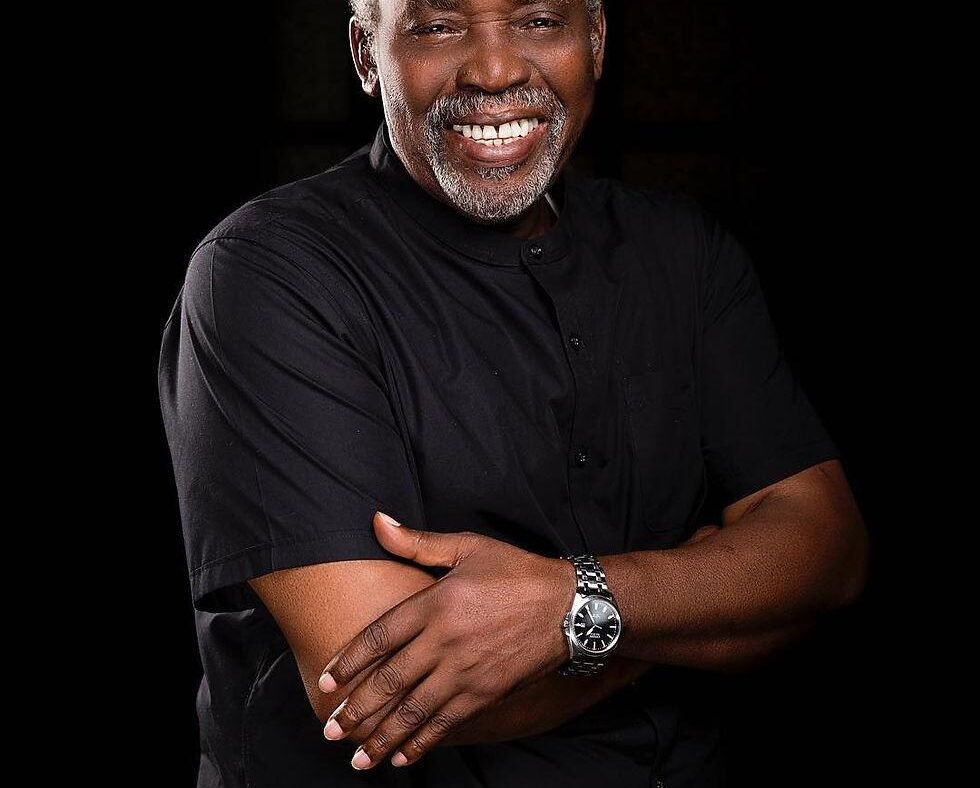
An Elegy for Olu Jacobs
By Dr. Pedro Obaseki
The news reached me this evening, and something inside me fell silent.
Olu Jacobs is dead.
It is difficult to write those words because there are men whose presence becomes so woven into the fabric of an age that we imagine they will always be there—standing just beyond the curtain, waiting for another entrance; that unmistakable voice ready to fill the room.
But the curtain has fallen.
Tonight, I mourn not merely one of Africa’s greatest actors, but a man I knew, admired, laboured beside and loved.
I mourn our Uncle Olu.
My first vivid memory of Olu Jacobs goes back to 1995. I was then working at DBN TV, presenting D&E Connexion with my friend Ebere Young Acharike, and directing TeenTV with Chichi Okaro, when one day he walked into our premises on Awolowo Road. People recognised him instantly from The Third Eye, the television series in which he played Inspector Best Idafa with such effortless authority.
I recognised him too—but from somewhere farther away, somewhere that had first introduced me to the sheer power of his screen presence.
When I was a secondary school boy in Unity School Agbarho-Warri, I had seen him in Ashanti, surrounded by international stars such as Michael Caine, Peter Ustinov and Omar Sharif. Yet Olu Jacobs did not disappear among them. He did not carry himself like a man grateful merely to have entered the frame.
He belonged there.
Then came The Dogs of War, and again he demonstrated what became one of the defining truths of his career: Olu Jacobs required no concession to stand beside the finest actors anywhere in the world.
He possessed the training, the discipline, the voice and, above all, the presence.
When we met properly at DBN, a friendship began.
Whenever Uncle Olu was in my area in Surulere, Lagos, he would pay me a visit. Our conversations travelled across theatre, film, culture and the possibilities of the emerging Nigerian motion-picture industry. Long before Nollywood became a global word, Olu Jacobs understood that talent was not enough, that acting was not simply a pastime for gifted people. It was a profession. He studied it. He prepared for it. He honoured it.
Our friendship soon moved beyond conversation. Working with him was an education.
He always arrived prepared. He respected the script, the director, the crew and the audience. Once Olu Jacobs entered a character, he possessed it completely. He did not merely recite dialogue; he gave words bone, breath and authority.
His generosity extended beyond the screen. When my younger sister, Iyen Agbonifo-Obaseki, became the inaugural President of the Creative Designers Guild of Nigeria, Uncle Olu stood with us. When my protégé, Lancelot Oduwa Imasuen, prepared to film Adesuwa in Benin City, Olu Jacobs came and brought his immense stature to the role of the Ezomo.
He did not behave like an international star doing a younger filmmaker a favour.
He came as an actor serving the story.
That was his greatness.
But one memory has remained particularly precious to me.
In 1998, I was rehearsing my stage epic, Idia: The Epic of an African Queen. Joke Silva-Jacobs played the title role of Queen Idia.
And Olu Jacobs would come to rehearsals.
He was not in the play. There were no cameras waiting for him, no billing, no applause to receive. He came simply to support his wife.
I watched one of Africa’s most accomplished actors sit through rehearsals because the woman he loved was on that stage working.
That small gesture told me something profound about the man behind the enormous public persona. Behind the commanding voice and imposing screen presence was a husband who understood partnership; a great actor who could sit quietly in the shadows while another artist—his wife—occupied the light.
That was Olu Jacobs.
Our relationship travelled across many years and many corners of the creative industry. I saw at close quarters his professionalism, generosity and almost old-fashioned reverence for the actor’s craft.
Uncle Olu never needed to announce his greatness.
He carried it.
And beside him, through those extraordinary decades, stood Joke Silva-Jacobs—not merely his wife, but his creative companion and fellow traveller. Together they represented something increasingly precious in our industry: talent anchored by discipline, fame moderated by dignity, and marriage strengthened by mutual respect.
Olu Jacobs belonged to that rare generation that connected worlds. He carried the rigour of the British stage into Nigerian television and cinema and ultimately into the extraordinary experiment that became Nollywood.
He became a bridge between generations.
And now that bridge has entered history.
To Joke, their children, the Lufodo family of students and colleagues, and the enormous fraternity of actors, directors, writers and theatre practitioners whose lives Uncle Olu touched, I offer my deepest condolences.
But tonight, my memories are simpler.
I remember the conversations.
I remember the rehearsals.
I remember the friendship.
And I shall remember the telephone ringing and that unmistakable voice greeting me:
“Ah, Don P!”
And I would answer:
“Baba!”
Tonight, Uncle Olu, the stage is strangely empty.
The lights have dimmed. The cameras have stopped rolling. The great voice has fallen silent.
But the work remains.
The lessons remain.
The generations you inspired remain.
You came. You laboured. You conquered.
Goodnight, Uncle Olu.
Don P will miss you.
- Dr. Pedro Obaseki is a scholar, filmmaker, broadcaster, playwright and political strategist; a former African Performance Consultant at the Kennedy Center for the Performing Arts; a Fellow of Theatre Arts (fta), Patron of the Association of Movie Producers (AMP), Nigeria and pioneer President of the Filmmakers’ Cooperative of Nigeria.