Atiku adviser says purchasing power, petrol prices and household welfare will shape the election; defends ADC coalition and policy alternatives
By The African Comet
ABUJA — A Director of the African Democratic Congress Presidential Campaign Council and adviser to Atiku Abubakar on policy and strategy, Dr. Pedro Obaseki, has dismissed suggestions that the number of governors and political leaders backing President Bola Tinubu will guarantee his re-election, arguing that economic hardship will weigh more heavily on voters’ choices in 2027.
Speaking during an interview on Real FM, Abuja, with presenters Miss Mimi Delekpe and Ugochukwu, Obaseki said political endorsements should not be mistaken for ownership of the electorate, particularly when households are struggling with the cost of living.
He identified declining purchasing power, petrol prices, inflation and household welfare as issues he believed would determine the presidential contest.
“The depletion in the purchasing power will speak. The prices of petrol will speak,” he said.
Obaseki’s remarks came during an exchange over the significance of prominent political figures supporting Tinubu and the extent to which their influence could strengthen the All Progressives Congress ahead of the election.
He argued that assessments built mainly around governors, campaign appointments and public declarations overlooked the ability of voters to make independent decisions.
He cited Atiku’s victory in Katsina and Peter Obi’s wins in Lagos and the Federal Capital Territory in 2023.
For Obaseki, those outcomes illustrated the limits of assuming that political officeholders could automatically deliver the electorate to their preferred presidential candidate.
Challenged by the presenters on whether influential leaders still commanded substantial support, he maintained that their endorsements had to be tested against conditions in communities and the concerns of ordinary Nigerians.
He urged broadcasters to engage residents in markets and neighbourhoods rather than rely exclusively on statements from political leaders, arguing that such conversations would offer a clearer sense of public sentiment.
Obaseki also questioned the ideological foundations of political arrangements bringing figures from different parties into Tinubu’s campaign orbit.
Drawing an analogy with chemistry, he distinguished between a mixture and a compound, suggesting that assembling prominent personalities did not necessarily produce a coherent political organisation.
He described the arrangement as a “political mixture of strange bedfellows” and argued that its public appearance of strength could conceal conflicting interests.
Turning to Atiku’s campaign, Obaseki said the ADC’s approach was to challenge the administration’s record issue by issue while presenting alternatives that voters could assess alongside government policy.
He argued that the opposition’s task extended beyond criticism of the incumbent and required it to demonstrate how a different administration would address the country’s difficulties.
Obaseki cited Atiku’s petroleum subsidy proposal as one example of that approach, defending it as part of the campaign’s response to the pressures facing Nigerian consumers.
He criticised the APC’s response to the proposal and argued that government efforts to ease transport costs acknowledged the underlying affordability problem the opposition had raised.
Returning to the electoral significance of those pressures, he rejected the suggestion that large campaign gatherings necessarily provided a reliable measure of how people would vote.
In his assessment, the public visibility of support groups had to be weighed against voters’ experiences of prices, income and insecurity.
The presenters also challenged Obaseki on Atiku’s movement between political parties, asking how that history could be reconciled with his criticism of alliances involving figures from rival parties.
In response, he drew a distinction between changing platforms across election cycles and remaining within one party while working against its presidential candidate.
He attributed the departure of Atiku and other opposition figures from the Peoples Democratic Party to an internal crisis which, in his account, had denied them an effective political platform.
Obaseki accused Federal Capital Territory Minister Nyesom Wike of undermining the PDP’s opposition role, describing the ADC as an alternative platform for politicians seeking to contest elections outside the governing party.
Asked what made Atiku’s latest presidential bid different, he pointed to the former vice-president’s experience in economic management and argued that serving as vice-president was distinct from exercising presidential authority.
He maintained that ultimate responsibility for an administration rested with the president, while presenting Atiku’s previous responsibilities as evidence of his preparedness for the office.
Obaseki also rejected suggestions that the ADC lacked a meaningful coalition capable of challenging the APC.
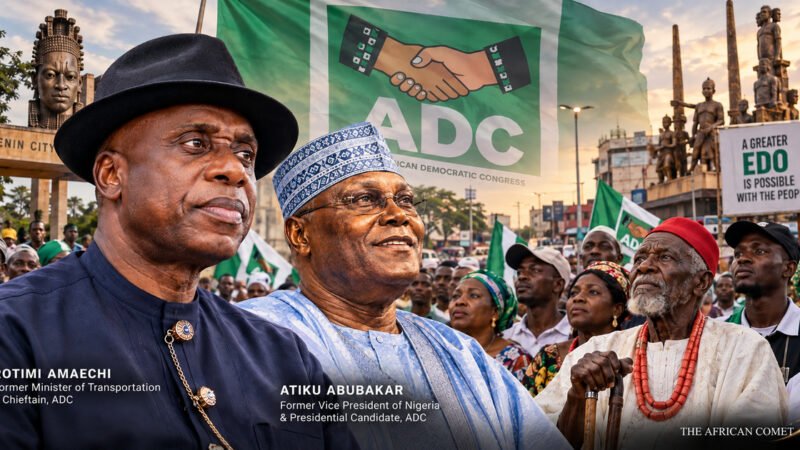
He cited Rotimi Amaechi’s participation in the alliance and argued that the presence of politicians drawn from different political backgrounds remained evidence of its coalition character.
Although he expressed confidence in Atiku’s prospects, his central argument throughout the interview was that the presidential election would ultimately turn on voters’ judgments of their circumstances.
Governors’ endorsements, campaign crowds and political realignments, he maintained, would have to withstand that test at the ballot box.
Real_FM_Interview_African_Comet_News_Report.md