WIKE, APC GOVERNORS AND THE RAINBOW COALITION BATTLE AHEAD OF 2027
Kapo Ajantala reporting
ABUJA — A curious political battle is unfolding inside the coalition backing President Bola Ahmed Tinubu’s re-election in 2027. It is no longer being conducted in whispers.
On one side stand governors of the All Progressives Congress (APC), uneasy with an arrangement that asks Nigerians to return Tinubu as President while leaving them free to vote against APC candidates further down the ballot. Several of those governors are themselves on that ballot, as Senate candidates.
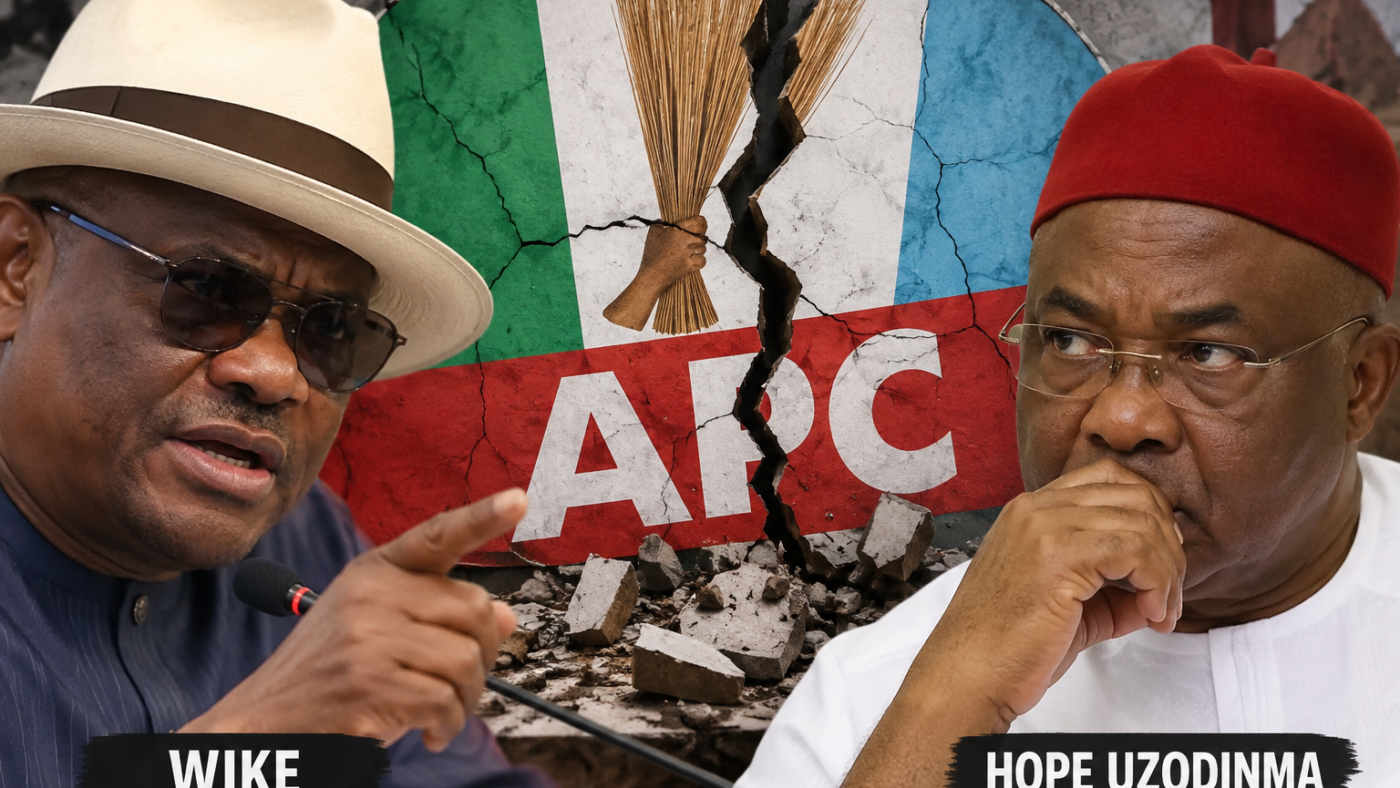
On the other stands Nyesom Wike, Minister of the Federal Capital Territory, still a member of the Peoples Democratic Party (PDP), and one of Tinubu’s loudest advocates. Between them sits an unusual political creature: the Rainbow Coalition.
The fault line is simple. The governors insist a presidential campaign cannot be separated from the party whose flag the President carries. Wike argues that it can. That may sound theoretical. It is anything but.
THE GOVERNORS DRAW A LINE
On the night of Monday, 14 September, the Progressive Governors’ Forum met behind closed doors at the Imo State Governor’s Lodge in Abuja. Reading the communiqué afterwards, its chairman, Imo Governor Hope Uzodimma, said APC governors would not support or endorse any arrangement capable of creating divided loyalties or weakening the party, and would back only candidates officially sponsored by the APC.
The messenger matters as much as the message. Uzodimma is also Secretary of the Tinubu Campaign Council. The objection to Wike’s coalition is coming from inside the President’s own campaign structure.
The communiqué did not name Wike. It did not need to.
WIKE HITS BACK
Wike’s answer has been emphatic: he promised to support Tinubu, not the APC.
In a statement through his aide, Lere Olayinka, he described the Rainbow Coalition as a cross-party platform, not an APC project. “Politics is local,” he said, urging governors to fix problems in their own states rather than whipping up sentiment around the President’s re-election. The statement also took an unmistakable swipe at Uzodimma, who came fourth in Imo’s 2019 governorship election before the Supreme Court declared him winner. Earlier, on Arise Television, Wike had called the governors opposing him “politically lazy.”
His substantive argument reaches back to 2023, when voters split their ballots between the presidential and National Assembly contests on the same day. He has repeatedly cited Imo as proof. In practical terms, a Rainbow supporter could vote APC for President and PDP for Senator. To Wike, there is nothing contradictory about that.
The real question is not whether Nigerian voters can split their choices. It is what happens when competing machines deliberately ask them to.
THE NUMBERS BEHIND THE NOISE
INEC’s final lists, published last weekend, put candidates before voters for 109 Senate and 360 House of Representatives seats. The APC is fielding candidates for all 469 National Assembly seats. The PDP has 103 Senate and 302 House candidates.
The same list explains why this quarrel is personal. Governors AbdulRahman AbdulRazaq (Kwara), Uzodimma (Imo), Muhammadu Inuwa Yahaya (Gombe), Dapo Abiodun (Ogun), Mai Mala Buni (Yobe) and Abdullahi Sule (Nasarawa) are all running for the Senate. For them, a coalition that campaigns for Tinubu while strengthening PDP senatorial candidates may be the name on the ballot beside their own.
Wike has singled out AbdulRazaq and Uzodimma, accusing both of being behind attacks on his coalition. In Kwara, defections have already given the argument electoral teeth.
Some commentary attributes all 103 PDP senatorial candidates to Wike’s network. That claim requires caution; the numbers alone do not establish it. What is established is that the coalition has become significant in several states, with Rivers, Kwara, Gombe and Cross River drawing particular attention, and that the governors were concerned enough to respond collectively. The battle is larger than Rivers. Its national reach should not be exaggerated.
ONE PRESIDENT, TWO MACHINES
Here Tinubu faces an unusual problem. Wike’s value to him rests on relationships outside the APC. Make him a conventional APC politician, and the appeal of a cross-party coalition disappears. Yet that same independence is what unsettles the governors.
Every PDP candidate Wike strengthens may be running against an APC candidate. Some APC leaders allege the coalition is sheltering politicians who lost APC primaries and are now contesting on the PDP ticket, which, if borne out, would erode governors’ grip on their state machinery. There are also reports, citing unnamed APC figures, that rivalry over the next National Assembly and positioning beyond 2027 is feeding the feud. Those remain unconfirmed claims.
The governors want Tinubu re-elected. Wike says he wants Tinubu re-elected. They disagree profoundly about what else should survive that re-election.
TINUBU’S DILEMMA
The President needs the governors, who remain central to party organisation and state-level mobilisation. But Wike occupies a different space: a PDP politician in an APC government whose relevance rests on the idea that loyalty to Tinubu need not mean membership of Tinubu’s party.
While their interests aligned, that ambiguity was useful. The election calendar is exposing its limits. A governor running for the Senate cannot be expected to cheer a coalition that may be backing his PDP opponent. Nor can Wike build a genuinely cross-party organisation if every member must support every APC candidate.
The stakes run beyond personalities. The senators and representatives elected on 16 January will shape the leadership of the legislature that confronts whoever takes the oath. The governors are defending a party ecosystem; Wike is defending a coalition built around one candidate. Both are operating around the same President.
WHAT HAPPENS NEXT?
The evidence does not show that Tinubu’s coalition has fractured, nor that every APC governor is at war with Wike. It shows something more precise: a serious dispute over whether the coalition backing an incumbent must also protect his party’s candidates.
The governors say yes. Wike says no.
That disagreement cannot stay abstract for long. As 16 January 2027 approaches, the Rainbow Coalition will test an unusual proposition in Nigerian presidential politics: can a political machine campaign to keep the man at the top while helping to defeat his party beneath him?
The answer will matter not only to Wike and the governors. It may determine what kind of coalition President Tinubu actually takes into the election.