
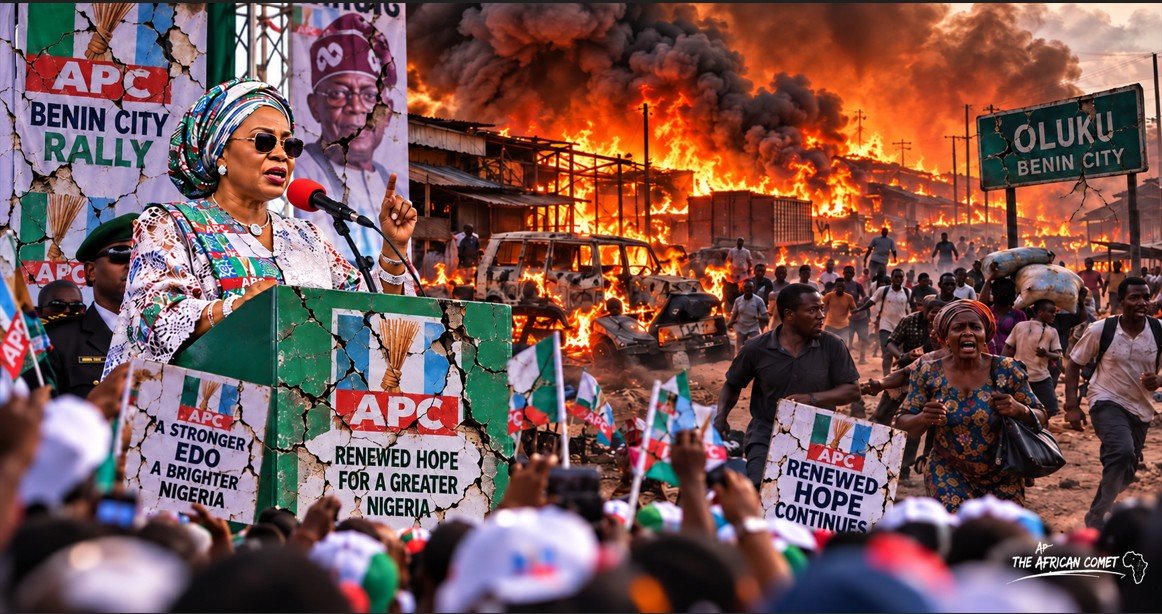
While the ruling party hosted Nigeria’s First Lady at a grand political gathering in Benin City, a devastating inferno swept through Oluku Market, raising troubling questions about emergency response and government priorities.
NEWS COMMENTARY | DR. PEDRO OBASEKI
BENIN CITY | OCTOBER 16, 2026
Thursday, October 15, 2026, will be remembered in Edo State as the day one city wore two faces.
At the Garrick Memorial grounds on Ekehuan Road, the political establishment assembled in splendour. The red carpet was rolled out. The dignitaries gathered. The speeches flowed. The cameras rolled. Nigeria’s First Lady, Senator Oluremi Tinubu, had landed at Benin Airport at about 11:18 a.m., received by Governor Monday Okpebholo and the hierarchy of the All Progressives Congress.
Thirty-two minutes later, on the outskirts of the city at Oluku, some kilometres away from the University of Benin, another spectacle began. Not one of political triumph, but of terror.
A petrol tanker that had overturned near Oluku Market on the Benin-Lagos Expressway burst into flames. The fire leapt into the market, swallowing shops, vehicles, merchandise and the hard-won livelihoods of struggling Nigerians.
The police confirm eight people injured, and the Federal Road Safety Corps says it has no confirmed death. Yet witnesses counted at several people dead, a soldier among them, and bodies were taken to the mortuary of the University of Benin Teaching Hospital.
One city. Two realities. At Garrick, the drums. At Oluku, the flames.
A DISASTER THAT GAVE ITS WARNING
The Oluku catastrophe was not an earthquake that struck without warning. It was a time bomb that ticked, loudly, for hours.
By the police’s own account, the tanker fell at about 7:30 a.m. and the fire ignited at about 11:50 a.m. Some witnesses put the fall as early as 4 a.m. Four hours on the police clock; nearly eight on the witnesses’.
Hours in which a tanker of petrol lay wounded and bleeding beside a crowded market, and a firm emergency response could have averted the tragedy.
The police say personnel were deployed and the public evacuated. Yet witnesses describe crowds with jerrycans still clustered around the spill, some turning on the soldiers and road marshals trying to drive them back. Reports say the fire erupted while the owner was trans-loading the remaining petrol into a second tanker, with scooping still under way.
Why was the danger zone not sealed? Who allowed trans-loading within reach of a crowd? And who, ultimately, was in command?
Those who scooped fuel were reckless, and some may have paid with their lives. But their recklessness cannot extinguish the responsibility of government. It is precisely because desperate people will run towards free petrol that the state must stand between them and the fire.
WHERE WERE THE FIREFIGHTERS WHEN OLUKU NEEDED THEM?
Benin City is not without firefighters: the state and federal fire services, and the fire units of the University of Benin and its Teaching Hospital, a short drive from Oluku.
Yet one widely shared post lamented almost five hours without a fire service response. Other accounts place firefighters at the scene before the blaze, among those the scoopers attacked.
These are not small contradictions. They are the whole story.
If the firefighters were absent, where were they? If they were present, how did a scene watched by soldiers, police, road marshals and fire officers fail to hold a cordon against a crowd of jerrycans for four hours? Either way, the failure was one of command, not chance.
Only a publicly verifiable timeline can settle it. When did the first call reach each fire service? When were engines dispatched, and when did they arrive? How many were serviceable, and how many deployed elsewhere?
Crucially, were any fire engines or personnel placed on standby for the First Lady’s visit?
That allegation has not been independently established and must not be presented as proven. But it is grave enough to demand a documented answer. If fire engines idled beside a ceremony while a market burned, that would be a scandal of extraordinary proportions. If not, let the authorities publish the dispatch records and settle the matter.
A government confident in its conduct should have nothing to fear from its own logbooks.
THE OBSCENITY OF MISPLACED PRIORITIES
Let nobody misunderstand the argument. The First Lady was in Benin to commission 50 compressed natural gas buses and launch a ₦1 billion programme giving ₦200,000 each to 5,000 Edo women.
A government can buy buses. It can raise marquees and fill a ground with cheering supporters in matching fabric. But can it protect a market woman from an avoidable catastrophe? Can it secure a highway after a tanker falls? Can it get fire engines to a burning market before the market becomes ash?
There is a bitter irony here. The women that programme set out to empower are the backbone of markets like Oluku. On the very day ₦200,000 was being pledged into some hands, the stalls and savings of others went up in smoke.
The question is not whether Senator Tinubu should have visited Edo. Of course she could. The question is whether the machinery of government was equally ready when the people needed it most.
BEYOND CONDOLENCES AND POLITICAL PUBLIC RELATIONS
While the Edo APC Campaign Council celebrated on stage at Garrick Memorial Grounds, the Chief Medical Director of the Teaching Hospital, Professor Idia Ize-Iyamu, who personally led her staff through the emergency and burns units, deserves particular commendation. Later, the APC issued a statement.
But the same statement warned against politicising the tragedy, holding up one tasteless social-media post as if every critic were dancing on the ashes.
Let me be clear. There was nothing to mock in Oluku’s smoke. But one careless post cannot become a fire blanket thrown over every legitimate question. The council says a tragedy is a tragedy, whichever party is in power. Agreed. And an inquiry is an inquiry, whichever party is in power.
Asking where the fire engines were is not politics. It is citizenship.
Condolences are not accountability. Government must establish how many died, how many were injured and what was lost, and close the gap between official figures and witness counts. Every trader must be documented; every burn victim properly treated.
An independent inquiry must trace the whole chain of events, from the moment the tanker fell to the last dying ember: the operator’s conduct, the cordon, fire service readiness and the deployment of safety resources during the First Lady’s visit. It must not become another ritual of committees and recommendations left to gather dust.
WHEN GOVERNMENT CELEBRATES, WHO PROTECTS THE PEOPLE?
Governor Okpebholo owes the people of Edo more than sympathy. He owes them an explanation: what happened, what failed, what worked and what will change. The Federal Government, too, must ensure its emergency institutions are never made to queue behind the ceremonial needs of the powerful.
For the traders of Oluku, October 15 was not a day of buses and speeches. It was the day years of struggle vanished in minutes. For those with terrible burns, the scars will outlast the last political banner.
Government is not measured by the number of dignitaries it receives, but by the number of ordinary lives it protects.
Whether October 15, 2026, becomes a landmark of accountability or another forgotten Nigerian tragedy depends on what Governor Okpebholo and the responsible authorities do next.
For now, one image will linger in the public conscience.
While Garrick applauded, Oluku burned.
And that is an indictment no amount of political pageantry can easily erase.
Dr. Pedro A. Obaseki, an Edo Citizen and resident, is a political strategist, public affairs commentator and media practitioner.