
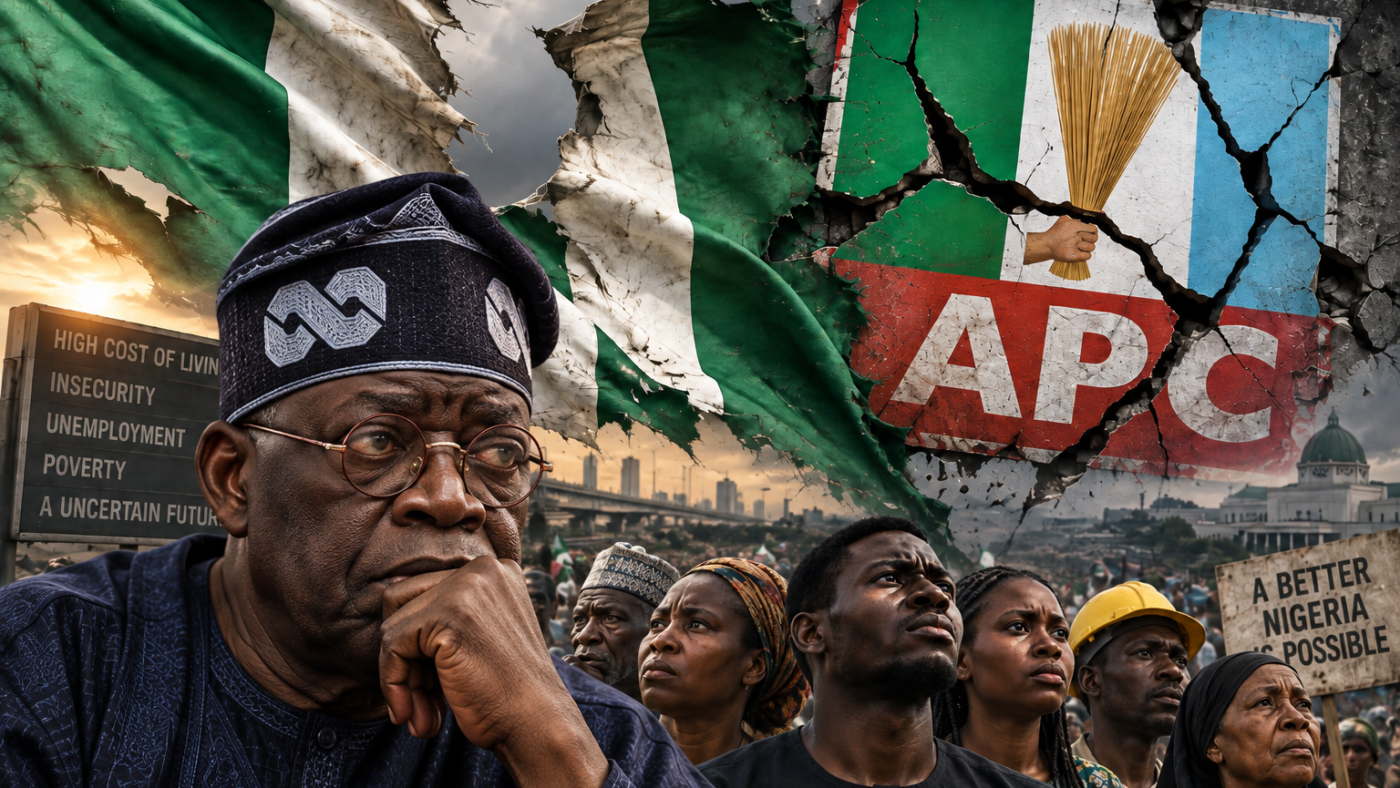
President Tinubu defended subsidy removal and his economic reforms in December 2024. But 21 months later, has any improvement reached the Nigerian household?
By The African Comet Editorial Board
On December 23, 2024, President Bola Ahmed Tinubu sat before Nigerian journalists for his first Presidential Media Chat since assuming office.
Nigeria was already hurting.
Petrol subsidy had disappeared. The naira had weakened dramatically. Transport, electricity and food costs had risen. Families were discovering almost weekly how much less their incomes could buy.
Tinubu was nevertheless emphatic.
“I have no regret removing petrol subsidy,” he declared.
On soaring prices, he was equally clear:
“I don’t believe in price control.”
His argument was straightforward: Nigeria had to endure painful structural reforms because the old economic order was unsustainable. Remove distortions, repair public finances, allow markets to function and, eventually, a stronger economy would emerge.
That was 21 months ago.
Enough time has passed to ask a harder question: whatever has happened to the economy, what has happened to the people?
Some Government Economists say the numbers are better, but are have our lives improved or worsened?
The Tinubu government says Nigeria’s economy expanded by 4.43 per cent in real terms in the second quarter of 2026, compared with 4.23 per cent a year earlier and 3.89 per cent in the first quarter of 2026.
The National Bureau of Statistics put headline inflation at 15.39 per cent in August 2026, with food inflation at 19.57 per cent. The Consumer Price Index (CPI) methodology was rebased in 2025, so comparisons with the old inflation series require caution, but the direction is clear: prices are still rising.
INFLATION FELL. PRICES DID NOT.
This is the distinction that matters at the kitchen table.
Lower inflation does not mean lower prices. It means prices are increasing more slowly.
Even as headline inflation fell to 15.39 per cent in August, the Consumer Price Index itself rose from 145.3 in July to 146.3 in August.
The Nigerian woman buying food does not purchase an inflation rate.
The worker entering a bus does not pay with GDP growth.
The small businessman cannot pour foreign reserves into his generator.
For ordinary people, the economy is experienced through the price of rice, transport, rent, electricity, school fees, medicines and petrol—and through what remains of a salary after those bills are paid.
And this is where the government’s victory narrative becomes more difficult.
PETROL STILL TRAVELS INTO EVERYTHING
In September 2026, filling stations checked in Lagos and Ogun were selling petrol at roughly ₦1,350 to ₦1,395 per litre, following another adjustment in refinery prices.
Petrol possesses a particular cruelty in Nigeria because it does not remain at the filling station.
It enters the bus fare.
It enters the cost of moving tomatoes from Kano and yams from Benue.
It enters the generator behind the barber’s shop, pharmacy, supermarket and factory.
Eventually, petrol arrives at the Nigerian dining table wearing another name.
That is why subsidy reform cannot be measured only by what government saved.
It must also be measured by what citizens were required to absorb.
HOUSEHOLD INCOMES HAVE NOT RECOVERED AND POVERTY REMAINS HIGH.
That single observation captures the contradiction of the present moment.
The Government says The economy is stabilising.
Many Nigerians are not.
The IMF was equally stark in June. It acknowledged that reforms had improved Nigeria’s macroeconomic outcomes and resilience, but estimated poverty at 63 per cent under the national poverty line, while about 27 million Nigerians faced food insecurity in the latter part of 2025.
This is not an opposition party speaking.
These are institutions broadly supportive of economic reform warning that macroeconomic repair has not yet translated into human relief.
A reform cannot be called socially complete while the figures improve faster than the lives beneath them.
AND THEN THERE IS SECURITY
Economic pain is only part of the burden.
Between July 2025 and June 2026, SBM Intelligence recorded at least 7,825 people abducted across 1,713 kidnapping-related incidents, a 66 per cent increase in victims over the preceding cycle. At least 1,142 people were reported killed.
These are monitoring estimates rather than a complete official census, but their scale cannot simply be waved away.
For the farmer afraid to reach his field, the parent worried about a child at school or the traveller calculating which highway is safe, insecurity is an economic condition too.
Fear has a price.
SO, ARE NIGERIANS BETTER OFF?
The honest answer is not contained in a slogan.
The evidence does not show an equivalent recovery in the lived economy of millions of citizens.
Food inflation remains nearly 20 per cent.
Petrol remains extremely expensive.
Household incomes have not fully recovered.
Poverty remains severe.
Food insecurity affects millions.
Kidnapping remains a grave national problem.
Those are not political insults.
They are measurements.
President Tinubu asked Nigerians to endure pain because reform would ultimately produce prosperity. He says figures now reasonably point to a more stable macroeconomic foundation as evidence that some part of that argument is working.
But the Nigerian citizen is entitled to ask the question government statistics cannot answer for him:
When does the recovery reach my home?
Because economies do not exist merely to impress economists.
Budgets are not written for spreadsheets.
Governments are not elected to rescue indicators while human beings remain submerged beneath them.
The ultimate measure of reform is not whether Abuja can announce that the economy has stabilised.
It is whether the woman in the market, the man at the bus stop, the farmer on his land and the family around the dinner table can feel that something in their own lives has finally begun to stabilise too.
But the recovery of the Nigerian remains only in Tinubu’s government spreadsheets. As for the ordinary Nigerian, Tinubu’s economic policies have made him poorer than any time in our recorded history. For the average Nigerian, his poverty is not a government statistic. His poverty is a fact he lives through every single day.